The Workflow Library
HomeKits › How do I run a recruitment agency on HubSpot?

How do I run a recruitment agency on HubSpot?

Short answer

Start with the split. A recruitment agency runs two pipelines, business development to win the mandate and placement to move a candidate, and they must never share a forecast. Add a pipeline type property to deals, a candidate side model on contacts with skills, availability and right to work, and a Vacancy custom object if you are on Enterprise. Then route candidates by desk with a first contact clock. Professional is the floor. The trap: nothing native fills a guarantee end date.

43 specsNeeds Sales Hub Professional or higherAbout 240 min for the core build1 spec needs Enterprise3 need Data Hub Pro10 also need Marketing Hub Pro5 free to read

The 43 specs, in build order

Each spec states its minimum tier. The ten free ones open in full, the others show their public preview.

Two pipelines, kept apartSets the pipeline type at deal creation and flags any deal sitting in a stage that does not belong to its type, so the mandate forecast and the placement forecast stop contaminating each other.
Deal type auto-classification (new business vs expansion)
A new deal gets classified as new business or expansion automatically, based on whether its associated company has a prior Closed Won deal, so...
Sales Hub Prodeal
Wrong pipeline-stage combination flag
A deal carrying a stage value that does not belong to its own pipeline, a state that should not be reachable through the UI but can appear after...
Sales Hub Prodeal
Duplicate open-deal detection per company
A new open deal gets flagged when its associated company already has another open deal, so reps consolidate instead of running two competing deals...
Sales Hub Prodeal
Deal without an associated contact flag
Any open deal missing an associated contact gets flagged, so reps fix the gap before it blocks reporting or a handoff.
Sales Hub Prodeal
A candidate record you can branch onRequired fields at creation, duplicate detection for the same person applying through three job boards, title standardisation, and consent captured per channel at the point of entry.
Required field enforcement on contact creation (email or phone missing)
New contacts missing a usable email or phone number are flagged and routed to a cleanup queue instead of sitting incomplete and unnoticed.
Sales Hub Procontactfree, complete
Duplicate contact detection and merge review queue
Contacts that look like duplicates of an existing record are flagged into a review queue within minutes of creation, instead of being discovered...
Data Hub Procontact
Job title standardization via lookup mapping
Job titles entered as free text ("VP Sales", "Vice President of Sales", "Sales VP") collapse into one standard title, so persona-based...
Data Hub Procontact
GDPR legal basis capture and consent workflow on EU form submission
EU-region contacts without a confirmed legal basis for marketing processing are held back from marketing sends and flagged for review, instead of...
Marketing Hub Procontact
Subscription status per channel (email, SMS, WhatsApp) from one preference form
A contact manages email, SMS, and WhatsApp opt-in status from one preference form, and the workflow catches the cases the form alone cannot: a...
Marketing Hub Procontact
Candidates to the right desk, on a clockAssignment by discipline and sector with immediate starts jumping the queue, a first contact SLA with a manager escalation, and the rules that protect returning candidates and cover absent recruiters.
Candidate assignment to the right recruiter by skill and availability, with a first-contact SLA
Every new candidate lands with a recruiter who works that discipline, the immediately available ones jump the queue, and a manager hears about it...
Sales Hub Procontact
Round-robin lead assignment by territory
New leads are split into territory groups and each group is assigned to the right owner pool in round-robin order, with no manual triage.
Sales Hub Procontactfree, complete
First-contact SLA timer with owner reminder task
Every newly assigned lead gets a countdown: the owner is reminded before the SLA expires, and a manager is notified the moment it does, so no lead...
Sales Hub Procontact
Reassign lead when owner has no activity within SLA window
A lead that its owner has not touched within the agreed window is automatically pulled off that owner and handed to another rep, instead of...
Sales Hub Procontact
Show the 5 other specs in this group
Assign leads by industry vertical
A lead lands with the rep who specializes in their industry, so the first call already speaks the right language instead of a generalist relaying...
Sales Hub Procontact
Route leads by product/service interest (form field or page viewed)
A lead interested in one specific product line goes to the rep who sells that product, instead of a generalist who has to hand it off after discovery.
Sales Hub Procontact
Weighted round-robin by rep capacity (custom property counter)
Leads split across the team in proportion to each rep's actual capacity (a senior full-time rep gets more, a part-time or ramping rep gets less)...
Sales Hub Procontact
Route existing-customer inquiry to current owner instead of round-robin
A new inquiry from an existing customer reaches their current owner directly, instead of falling through the cracks because your new-lead...
Sales Hub Procontact
Vacation / out-of-office rerouting (property flag pauses assignment to a rep)
New leads skip a rep who is currently out of office, and any lead assigned to them just before they left gets pulled back into rotation if nobody...
Sales Hub Procontact
Winning the mandateThe business development side: hiring manager outreach on qualification, the handoff into the intake call, an intake playbook attached to the deal, and a reminder before the fee agreement expires.
Auto-enroll contact in sales sequence when lead status becomes Sales Qualified Lead
A contact starts a personal sales sequence automatically the moment a rep or a scoring rule marks them as sales-qualified, with no manual "select...
Sales Hub Enterprisecontactfree, complete
Create SDR-to-AE handoff task when a meeting is booked
The moment an SDR-booked discovery meeting lands on an AE's calendar, the AE gets a task carrying the context they need (who booked it, why, what...
Sales Hub Procontact
Attach a discovery-call playbook link as a task when a deal is created
A new deal automatically gets a task pointing the owner to the standard discovery-call playbook, so reps stop asking sales ops which questions to...
Sales Hub Prodeal
SDR-to-AE handoff: create a deal and associate the contact when a meeting outcome is marked qualified
A qualified discovery call produces a deal in the AE's pipeline automatically, with the contact already associated, instead of an SDR manually...
Sales Hub Procontact
Task reminder before a quote's expiration date
A rep gets a task a few days before a live quote expires, with enough time to extend it or push for a decision before the buyer loses the ability...
Sales Hub Proquote
From submission to first dayChase and escalation when a client goes quiet on a shortlist, stage tasks and rejection reasons on the placement pipeline, then the pre start pack, the start date stamp and the first day confirmation.
Submission chase and escalation when a client gives no feedback
A candidate sent to a client is chased on a schedule instead of on memory, and after two silent rounds the account owner is told, so a submission...
Sales Hub Prodeal
Task creation when a deal enters a pipeline stage
Every time a deal moves into a defined stage, the right next-action task is created automatically, so reps stop guessing what to do next.
Sales Hub Prodeal
Require and capture win/loss reason on Closed Lost
No deal reaches Closed Lost without a standardized loss reason on file, so loss analysis is based on real data instead of guesswork.
Sales Hub Prodeal
Days-in-current-stage property tracker
Every deal carries a single, always-current "date entered current stage" property, so a report or list filter can flag deals sitting too long in...
Sales Hub Prodeal
Show the 4 other specs in this group
Sales-to-CS handoff task on deal closed won
The moment a deal is marked Closed Won, the customer success owner gets a task and a notification, so no new customer sits in a gap between sales...
Sales Hub Prodealfree, complete
Onboarding checklist tasks created on deal closed won
A fixed sequence of onboarding tasks, spread over the first weeks of the account, is created and assigned automatically as soon as a deal closes,...
Sales Hub Prodeal
Kickoff-not-booked reminder and escalation
If a new customer has not booked their kickoff call a few business days after the invite went out, the onboarding owner gets a reminder, and if it...
Sales Hub Prodeal
Onboarding start date property set on deal closed won
Every closed-won deal gets a single, reliable timestamp for when onboarding began, so reporting on time-to-value and onboarding duration has a...
Sales Hub Prodeal
After the start: guarantee, care desk, databaseThe in seat check before the rebate window closes with the redeployment path when a placement fails, the worker care queues for pay, timesheet and compliance, and the cadence that keeps a dormant database worth something.
Guarantee period end check and candidate redeployment
Before the rebate window closes, somebody confirms the placed candidate is still in the seat, and when a placement has failed the candidate goes...
Sales Hub Prodeal
Recurring onboarding check-in task cadence
The onboarding owner gets a fresh check-in task every week for as long as the onboarding ticket stays open, capped at a fixed number of cycles,...
Service Hub Proticket
Data-verified checkbox with periodic review reminder
Contacts marked as verified automatically come back up for review after a fixed interval, instead of a verified checkbox staying checked forever...
Data Hub Procontact
Round-robin ticket assignment by team/queue
New tickets are split into queues by pipeline or category and each queue rotates assignment evenly across its rep pool, so no ticket sits unowned.
Service Hub Proticketfree, complete
Show the 8 other specs in this group
SLA "Time to first response" breach alert to owner and manager
The moment a ticket's first-response SLA target is missed, the assigned rep and their manager both get an internal alert, instead of the breach...
Service Hub Proticket
Ticket routing by category/product property to a specialized queue
New tickets route straight to the support pool that owns the relevant product or category, instead of landing in one shared queue for manual triage.
Service Hub Proticket
Auto-close inactive tickets after N days without a contact reply
A ticket that has been waiting on the customer with no reply for N days after a warning closes automatically, keeping open-ticket counts honest...
Service Hub Proticket
SLA clock pause while ticket status is "Waiting on contact"
Time spent waiting on the customer to reply stops counting against the team's SLA, and the portal keeps a visible record of how long each waiting...
Service Hub Proticket
Re-engagement sequence for cold or inactive contacts
Contacts who have gone quiet for a defined stretch get one last, deliberately light-touch sequence to earn a click before being suppressed from...
Marketing Hub Procontact
Job title / seniority based nurture branch
A contact gets messaging pitched at the right altitude, strategic framing for a senior title and hands-on detail for an individual contributor,...
Marketing Hub Procontact
Quarterly always-on touch for stalled or dormant leads
Contacts in the Lead stage keep getting one relevant email every quarter for as long as they stay a Lead, so nobody falls off the radar entirely...
Marketing Hub Procontact
Sunset / final-attempt re-engagement before suppression
Long-inactive contacts get one clear final email before being moved off active marketing sending, protecting deliverability without silently...
Marketing Hub Procontact

What a spec looks like

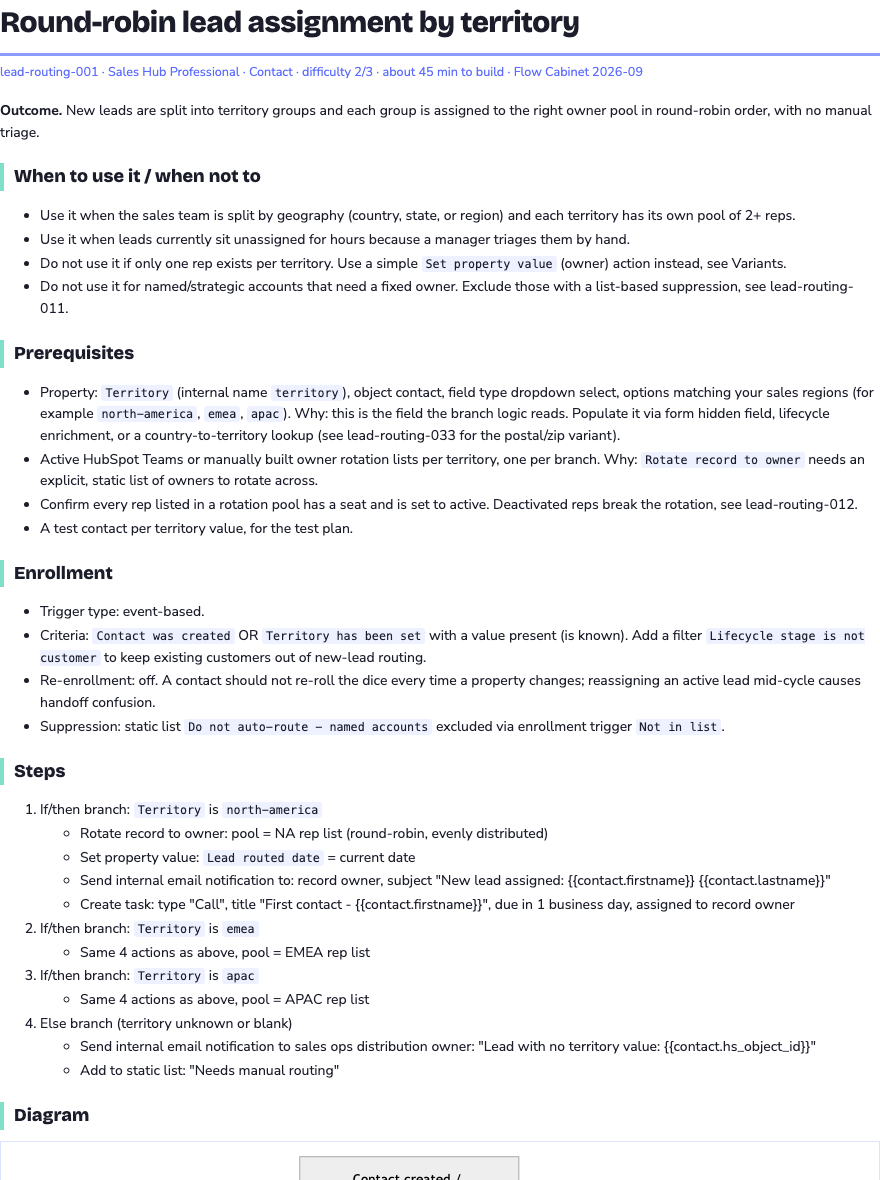
Every spec follows the same nine sections, so a team reads one and knows how to read all of them.

  • Outcome, when to use it and when not to
  • Prerequisites: properties, lists, tiers, with the JSON to create them
  • Enrollment and re-enrollment, then every step with its parameters
  • Known pitfalls, a test plan, variants, and the YAML build spec
First page of a spec

What breaks, and how the specs prevent it

One pipeline carrying two businesses

A mandate worth forty thousand and a placement fee worth six thousand sitting in the same pipeline sum into one forecast that means nothing. Conversion rates are worse: winning a mandate and placing a candidate have different odds and different cycle times, and averaged together they describe neither. The fix is one property read by every enrollment filter and every report, plus a spec that flags the deals that end up in the wrong stage anyway, because somebody will drag one across within the first week.

The guarantee date that nothing fills

Every aftercare workflow in an agency hangs off a guarantee or rebate end date, and HubSpot has no native way to add a number of days to a date inside a workflow. Leave it blank and the workflow enrolls nobody, reports no error, and looks healthy in the list of active workflows. You fill it with a custom coded action at Closed Won, which needs Data Hub Professional, or by hand on every placement. The kit says which, rather than pretending the calculation is native.

Chasing by stage instead of by reply

The submission chase reads the deal stage, because that is the only signal a workflow can see. A hiring manager who gives feedback by phone stops nothing, so the recruiter gets a task to chase something they already know. Tell the desk before turning it on, and make moving the stage the habit. The same applies to the first contact clock on candidates: it reads the last contacted date, which only updates for activity actually logged in the portal.

What this bundle builds

How the pieces fit together

Build the split first. Nothing downstream reports correctly until pipeline type exists and is set automatically, because every enrollment filter in the kit reads it.

Then the candidate record, because routing branches on fields that have to be populated and clean before they can be branched on. Skills as a fixed option list, not parsed text. Required fields and duplicate detection before either, or the first week of routing runs on three copies of the same person.

Routing comes third and needs both: it reads skills, availability and the redeployment flag, and it stamps the date the SLA clock starts from. The business development specs are independent and can be built in parallel by a second person.

The placement specs come fourth because they depend on the pipeline stages existing. Aftercare comes last, and only after the guarantee end date is being filled on every Closed Won placement, since that single date is what the whole final component enrolls on.

What you get

  • 43 workflow specs: 40 selected from the library plus 3 written for agencies, covering 8 categories.
  • Each spec ships as PDF and Markdown, with prerequisites, exact enrollment criteria, numbered steps, a diagram, known pitfalls, a test plan and variants.
  • Properties JSON per spec, plus the kit data model: 32 properties across contacts, companies, deals and tickets, ready for the properties batch create endpoint.
  • The Vacancy custom object schema, ready for the schemas endpoint, with 7 properties.
  • A README that explains every property, what reads it, and the order to create things in.
  • Workflow JSON in Automation API format, switched off on arrival.
  • Custom coded actions where a step has no native equivalent, with the tier that requires stated on the spec.
  • Test plans written for a test portal, and install in one click for Full and Agency buyers.

Who it is for, and who should skip it

What this kit builds

A portal that tells the truth about a recruitment agency. Today most of them run one pipeline with stages borrowed from a software sales template, a candidate database nobody trusts after the third job board duplicate, and aftercare that happens when somebody remembers.

The kit builds three things. A data model, thirty nine properties across contacts, companies, deals, tickets and a Vacancy object, with the reasoning for each one and the API bodies to create them. A pipeline split, so winning a mandate and placing a candidate stop sharing a forecast. And the automation that runs on top: candidates assigned to the desk that can actually place them, a first contact clock, a chase when a client goes quiet on a shortlist, the pre start compliance pack, and a check before the rebate window closes.

It fits an agency portal, permanent or contract, in house ops or the consultancy building for one. Sales Hub carries the two pipelines, Marketing Hub carries the candidate database and the consent model, Service Hub carries the worker care desk. A permanent only agency can drop the five ticket specs and lose nothing else.

Who it is for and who should skip it

It is for the person who owns the portal at a recruitment or staffing agency, or the consultant building one, and who is comfortable creating properties and workflows without being walked through the interface. First hour value is the pipeline split and the data model, before a single workflow is built.

Skip it if you are an in house talent team hiring your own staff. The model here sells placements to clients, and half of it is about mandates and fees you do not have. Skip it if you are on Starter, since most specs need Professional. And if you want the volume rather than the selection, take the full library and build the model from the README yourself.

Questions admins ask

Can I use HubSpot as a recruitment CRM without an applicant tracking system?

For an agency, mostly yes, and this kit is the mostly. Candidate records, desks, submissions, placements, guarantees and the care desk all model cleanly on contacts, deals, tickets and a custom object. What HubSpot does not give you is CV parsing, job board posting and candidate search on the text of a CV. Agencies that place high volume on parsed data keep a specialist tool for sourcing and use the portal for the relationship and the pipeline.

How do I keep business development and placement deals apart in HubSpot?

Two pipelines, and one property called pipeline type set at deal creation and read by every enrollment filter and report. Separate pipelines alone are not enough, because a deal moved by hand from one to the other keeps its old reporting shape. The kit includes the spec that sets the type automatically and the spec that flags any deal whose stage does not match its type, which is how the split survives contact with a sales floor.

Do I need a custom object for vacancies?

Only on Enterprise, and only if one role regularly carries several candidates. A vacancy is not a deal: one vacancy can hold six placement deals and be filled once. On Professional, hold the vacancy as a deal in the business development pipeline and accept that your time to fill is measured per candidate rather than per role. The kit ships the vacancy schema either way, so the upgrade path is a single API call.

Which HubSpot tier does this kit need?

Professional is the floor. Starter has form follow up and simple ticket routing, not branches, delays or rotation, so most of these specs cannot be built there. Custom objects and the Vacancy model are Enterprise. The guarantee date calculation and any webhook step need Data Hub Professional. Five of the forty three specs are ticket based and need Service Hub provisioned, and a permanent only agency can skip them.

How do I automate the guarantee or rebate period?

Store the rebate period in days on the client company, taken from the signed terms, and the start date on the placement deal. Adding the two gives the guarantee end date, and that addition is the part no workflow action performs, so it is a coded action or a manual entry. Once the date exists, a filter based workflow enrolls the placement a fortnight before it expires, raises the in seat check, and runs the redeployment path when the answer comes back badly.

Related

Built by a collective of independent HubSpot consultants, ten years of implementations behind them. Searched as: hubspot for recruiting, hubspot recruitment crm, hubspot for staffing agencies, hubspot recruitment workflow, hubspot candidate pipeline, hubspot for recruitment agencies. HubSpot calls it: Rotate record to owner, Create task, Copy property value, Send internal email notification, Custom object, Wait until. Version 2026-09-19.
199 EUR249
Get this kit