Outcome. Time spent waiting on the customer to reply stops counting against the team's SLA, and the portal keeps a visible record of how long each waiting period actually lasted, instead of the clock (or the team's sense of how long they took) treating that time as their own delay.
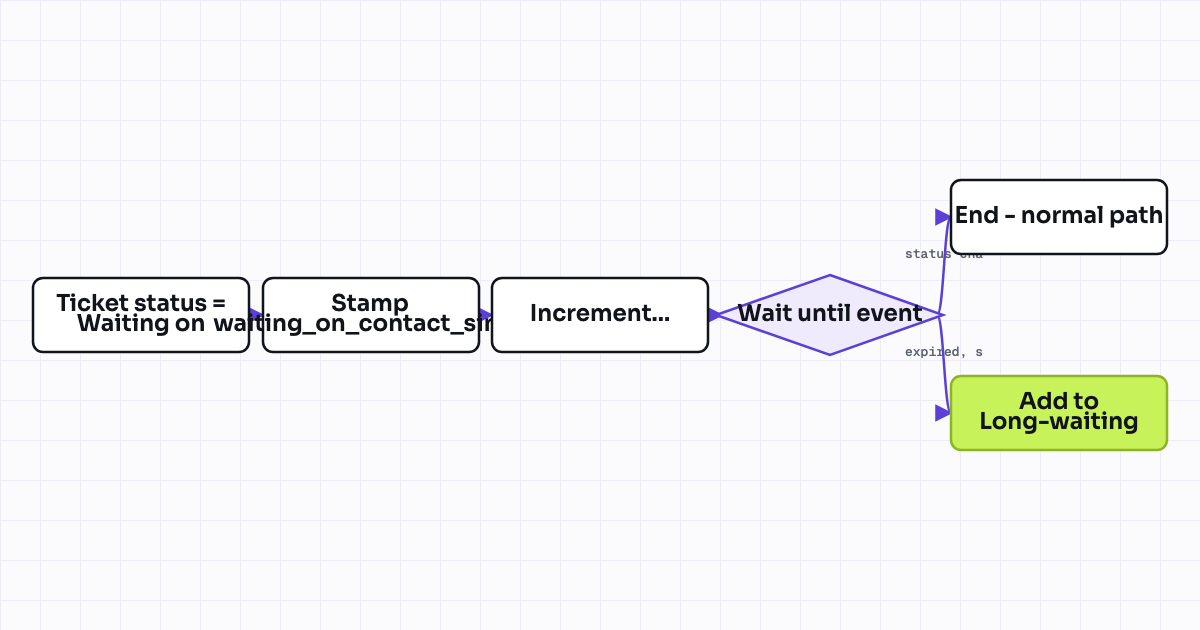
Workflow map
Enrollment, branches and actions at a glance
tickets-sla-020
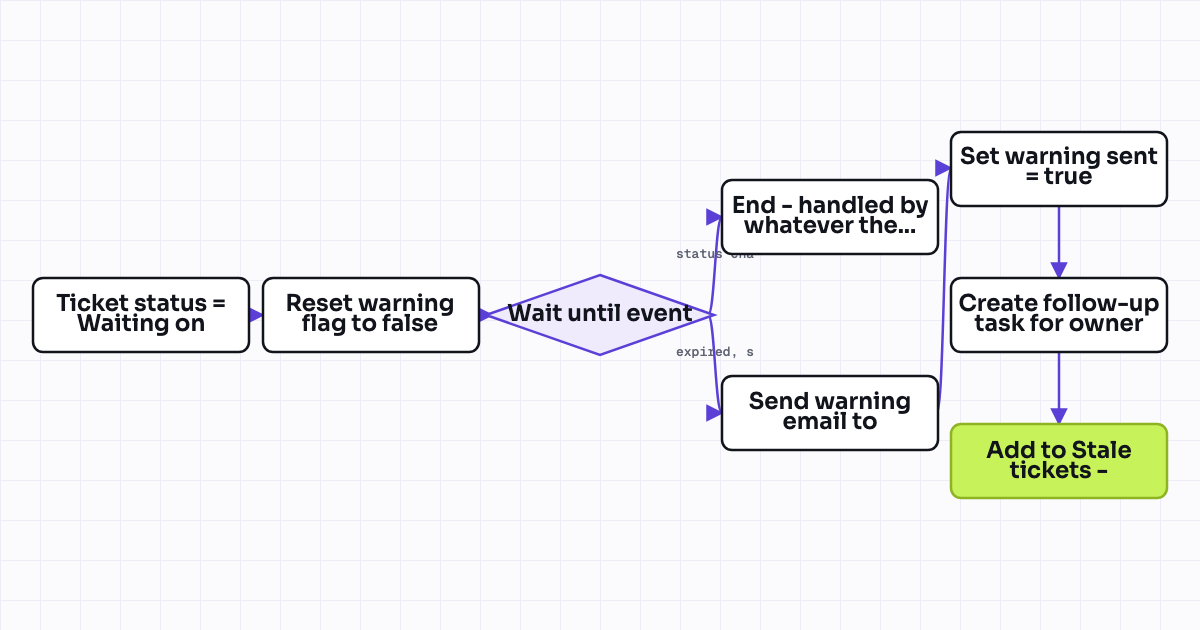
flowchart TD
    A[Ticket status = Waiting on contact] --> B[Stamp waiting_on_contact_since]
    B --> C[Increment waiting_on_contact_rounds]
    C --> D{Wait until event: status changes away - expires in 30 days}
    D -->|status changed| E[End - normal path, native SLA pause already applied while waiting]
    D -->|expired, still waiting| F[Add to Long-waiting tickets - review list]
When to use it, when not to
- UseUse it once your ticket pipeline stages are mapped to HubSpot's ticket status categories (Open, Waiting on contact, Waiting on us, Closed), since the actual SLA pause is a native platform behavior tied to that category, not something a workflow creates from scratch.
- UseUse it when the team wants visibility into how much time tickets actually spend waiting, for coaching or process review, on top of the native pause.
- SkipDo not use it expecting this workflow to be what pauses the SLA; if your pipeline stages are not mapped to the "Waiting on contact" status category, no amount of workflow logic recreates that native pause, fix the pipeline mapping first (check in your portal: confirm current status category configuration path, Settings > Objects > Tickets > Pipelines, or the newer Help Desk pipeline settings).
- SkipDo not use it if you have no interest in reporting on waiting time; the native pause already happens on its own regardless of whether this workflow exists.
The preview ends here. Six sections are in the library.
counted, not blurred
PrerequisitesEvery property with its label, internal name, type and options, plus the assets the workflow needs before you start.4 items
EnrollmentThe trigger, the criteria exactly as they are ticked in the UI, the re-enrollment rule and the suppression list.4 parts
StepsEach action in order with its parameters, its branches and its delays, written as you tick them.6 numbered actions
Known pitfallsTraps seen in production, each with what breaks and what to do instead.5 pitfalls
Test plan, variants and build specHow to prove it works in a test portal, where to look when it does not, the variants for other objects or tiers, and the YAML build spec.3 variants, 3 sections
FilesThe properties JSON creates the fields in one API call, the workflow JSON documents the build.PDF, Markdown, JSON
Install1 click. The installer creates the properties this spec declares and the workflow itself, switched off, then opens a task for the prerequisites that are assets rather than properties, such as a team, a static list or a marketing email. What it created is listed on the install page.1 click, switched off
Unlock the full library,
149 EUR
or the tickets and sla pack, 39 EUR
One-time, excl. VAT. 30-day refund, no questions asked. Founding prices until 31 October, then 199 and 59 EUR. Includes every spec added later, up to the full 500, and the one-click installer on the full library. Building on client portals? The agency licence at 449 EUR covers unlimited client portals.