The Workflow Library
HomeKits › How do I set up HubSpot for an insurance agency?

How do I set up HubSpot for an insurance agency?

Short answer

Start with the Policy object, because one household holds several policies with several different expiration dates and a single renewal date on the company record cannot hold them. Then the X date cascade at 90, 60 and 30 days before each expiration, then quote chasing, then the claims and certificates desk. Professional tier for most of it, Enterprise for the Policy object. The trap: a renewal cadence anchored on the account renews the first policy and forgets the other four.

43 specsNeeds Sales Hub Professional or higherAbout 140 min for the core build3 specs need Enterprise5 need Data Hub Pro12 also need Marketing Hub Pro4 free to read

The 43 specs, in build order

Each spec states its minimum tier. The ten free ones open in full, the others show their public preview.

The X date engineEvery policy works its own renewal calendar off its own expiration date, with the producer kept on the account and the premium carried onto the renewal deal.
Policy X date renewal cascade at 90, 60 and 30 days before expiration
Every policy in force works its own renewal calendar: the producer gets three tasks timed off the policy expiration date, the path changes with...
Sales Hub Enterprisecustom
Renewal deal auto-creation from contract end date
A renewal deal is created and associated to the account automatically 90 days before the contract ends, pre-filled with amount and owner, so no...
Sales Hub Procompanyfree, complete
Renewal reminder cascade to CSM/AM (90/60/30 days before contract end)
The account owner gets an increasingly urgent set of reminders at 90, 60, and 30 days before a contract ends, with a manager notified if nothing...
Sales Hub Procompany
Auto-renewal opt-out window reminder before lock-in date
The account owner gets a reminder while there is still time to decide, before a contract's auto-renewal clause locks the account into another term...
Sales Hub Procompany
Show the 4 other specs in this group
Renewal deal owner auto-assignment to current CSM/AM
A renewal deal is owned by whoever currently manages the account, not whoever happened to be the deal creator or the original sales rep, the...
Sales Hub Prodeal
Renewal deal amount pre-populated from current subscription value
A new renewal deal opens with a realistic amount already filled in, taken from what the account is actually paying today, instead of a blank field...
Sales Hub Prodeal
Next renewal date auto-set on renewal deal Closed Won
The moment a renewal deal closes won, the associated account's contract end date rolls forward to the next cycle and the renewal-creation flag...
Sales Hub Procompany
Renewal pipeline auto-routing separate from new-business pipeline
A deal that becomes a renewal always lands in the Renewal pipeline, even if it was created or edited outside the automated flows that normally...
Sales Hub Prodeal
Quote to boundThe quote is chased when it is not opened, followed up when it is read and not signed, and reminded before the rates have to be pulled again.
Notify rep when a sent quote is viewed by the buyer
The rep finds out the same day a buyer opens the quote, so follow-up happens while the quote is top of mind instead of days later on a routine...
Sales Hub Proquote
Create follow-up task when a quote is sent but not viewed after 3 days
A rep gets a task to manually nudge the buyer when a sent quote sits unopened for three days, instead of a forgotten quote quietly aging in the...
Sales Hub Proquote
Enroll contact in a short follow-up sequence when quote is viewed but not signed after 5 days
A buyer who opened a quote and then went quiet for five days gets a short, pre-written nudge sequence automatically, instead of waiting on the rep...
Sales Hub Enterprisequote
Task reminder before a quote's expiration date
A rep gets a task a few days before a live quote expires, with enough time to extend it or push for a decision before the buyer loses the ability...
Sales Hub Proquote
Show the 3 other specs in this group
Block a quote from being marked ready to send until required deal properties are filled in
A quote that gets marked ready for approval snaps back to draft with a clear note if the deal behind it is missing required fields, instead of...
Sales Hub Proquote
Closed-lost reason categorization with competitor capture
Every logged loss reason rolls up into a small set of reporting categories automatically, and a competitive loss triggers a dedicated capture...
Sales Hub Prodeal
Task reminder before an approaching close date
A rep gets a task a set number of days before a deal's close date, so the final push happens on purpose instead of the date arriving unnoticed.
Sales Hub Prodeal
Intake and the right producerA quote request lands with someone licensed to write it, in the right line, inside a response window, and an existing policyholder goes back to their own producer.
Round-robin lead assignment by territory
New leads are split into territory groups and each group is assigned to the right owner pool in round-robin order, with no manual triage.
Sales Hub Procontactfree, complete
First-contact SLA timer with owner reminder task
Every newly assigned lead gets a countdown: the owner is reminded before the SLA expires, and a manager is notified the moment it does, so no lead...
Sales Hub Procontact
Route leads by country / region to territory owner
New leads are routed straight to the correct territory pool based on the country or region on the record, with no separate territory field to keep...
Sales Hub Procontact
Route leads by product/service interest (form field or page viewed)
A lead interested in one specific product line goes to the rep who sells that product, instead of a generalist who has to hand it off after discovery.
Sales Hub Procontact
Show the 2 other specs in this group
Route existing-customer inquiry to current owner instead of round-robin
A new inquiry from an existing customer reaches their current owner directly, instead of falling through the cracks because your new-lead...
Sales Hub Procontact
New lead welcome nurture (post form-fill drip)
New contacts who fill a top-of-funnel form get a 4-email welcome drip over about two weeks that introduces the company and nudges toward a second...
Marketing Hub Procontactfree, complete
Claims, certificates and endorsementsThe service desk: first notice of loss out of hours, the acknowledgement clock, the wait on documents, certificate turnaround and mid term policy changes.
Certificate of insurance request: task, due date SLA and chase
A certificate request stops being an email somebody remembers. It becomes a ticket with a named holder, a date the insured actually needs it by,...
Service Hub Proticket
Policy endorsement: carrier chase, premium recalculation and notice to both sides
A mid term policy change is tracked from request to issued document: the carrier gets chased on a schedule, the policy record carries the new...
Service Hub Enterpriseticket
Ticket priority auto-set from source and keyword match
Every new ticket gets a priority value the moment it is created, based on where it came from and words in the subject line, instead of a rep...
Service Hub Proticket
SLA "Time to first response" breach alert to owner and manager
The moment a ticket's first-response SLA target is missed, the assigned rep and their manager both get an internal alert, instead of the breach...
Service Hub Proticket
Show the 6 other specs in this group
CSAT survey sent automatically when a ticket is closed
Every closed ticket automatically triggers a one-question satisfaction survey to the requester, without a rep remembering to send it.
Service Hub Proticket
Ticket escalation to manager when SLA time-to-close is breached
A ticket that blows past its time-to-close SLA target automatically escalates to a manager with full context, instead of staying open indefinitely...
Service Hub Proticket
Wait until customer reply (48-hour expiry), else auto-close warning
A ticket marked "waiting on contact" gets a 48-hour clock. If the customer replies in time, nothing extra happens. If not, the workflow warns the...
Service Hub Proticket
Ticket routing by category/product property to a specialized queue
New tickets route straight to the support pool that owns the relevant product or category, instead of landing in one shared queue for manual triage.
Service Hub Proticket
SLA clock pause while ticket status is "Waiting on contact"
Time spent waiting on the customer to reply stops counting against the team's SLA, and the portal keeps a visible record of how long each waiting...
Service Hub Proticket
After-hours escalation to an on-call rep via schedule property
An urgent ticket created outside business hours reaches whoever is on call that week, instead of waiting for the queue to open the next business...
Service Hub Proticket
Prospects waiting on their X dateThe quarterly touch that keeps a prospect warm until their current policy expires, with consent captured per channel so the reminder can go by text.
Demo request abandonment re-engagement
A contact who reaches the demo request page but never submits the form gets one re-engagement email with an easier next step, instead of being...
Marketing Hub Procontact
Quarterly always-on touch for stalled or dormant leads
Contacts in the Lead stage keep getting one relevant email every quarter for as long as they stay a Lead, so nobody falls off the radar entirely...
Marketing Hub Procontact
GDPR legal basis capture and consent workflow on EU form submission
EU-region contacts without a confirmed legal basis for marketing processing are held back from marketing sends and flagged for review, instead of...
Marketing Hub Procontact
Subscription status per channel (email, SMS, WhatsApp) from one preference form
A contact manages email, SMS, and WhatsApp opt-in status from one preference form, and the workflow catches the cases the form alone cannot: a...
Marketing Hub Procontact
Consent withdrawal cascades to suppress from active lists and stop nurture
The moment a contact withdraws consent, whether through a subscription unsubscribe or a manual request, the withdrawal cascades to a shared...
Marketing Hub Procontact
The book kept cleanHouseholds that stay whole, dates that survive the agency management system import, monoline accounts surfaced, and every book transfer logged.
Required field enforcement on contact creation (email or phone missing)
New contacts missing a usable email or phone number are flagged and routed to a cleanup queue instead of sitting incomplete and unnoticed.
Sales Hub Procontactfree, complete
Duplicate contact detection and merge review queue
Contacts that look like duplicates of an existing record are flagged into a review queue within minutes of creation, instead of being discovered...
Data Hub Procontact
Phone number formatting to a standard international format
Every contact's phone number lands in one consistent international format, so dialers, texting tools, and country-based segmentation all read the...
Data Hub Procontact
Format action: copy a field value between contact and associated company
A property value from a contact's associated company appears directly on the contact record, so list segmentation and exports that only read...
Data Hub Procontact
Show the 3 other specs in this group
Standardize date property format across import sources
A date property fed by multiple import sources in inconsistent formats reads and sorts correctly everywhere in HubSpot, instead of storing some...
Data Hub Procontact
Cross-sell trigger from single-product account detection
An account owner gets a cross-sell task the moment an account settles into using only one product, instead of that account staying single-product...
Sales Hub Procompany
Audit property: record owner change log (who owns what, when it changed)
Every time a deal's owner changes, a timeline note records who it changed from and to, and a timestamp property tracks when, so ownership history...
Data Hub Prodeal

What a spec looks like

Every spec follows the same nine sections, so a team reads one and knows how to read all of them.

  • Outcome, when to use it and when not to
  • Prerequisites: properties, lists, tiers, with the JSON to create them
  • Enrollment and re-enrollment, then every step with its parameters
  • Known pitfalls, a test plan, variants, and the YAML build spec
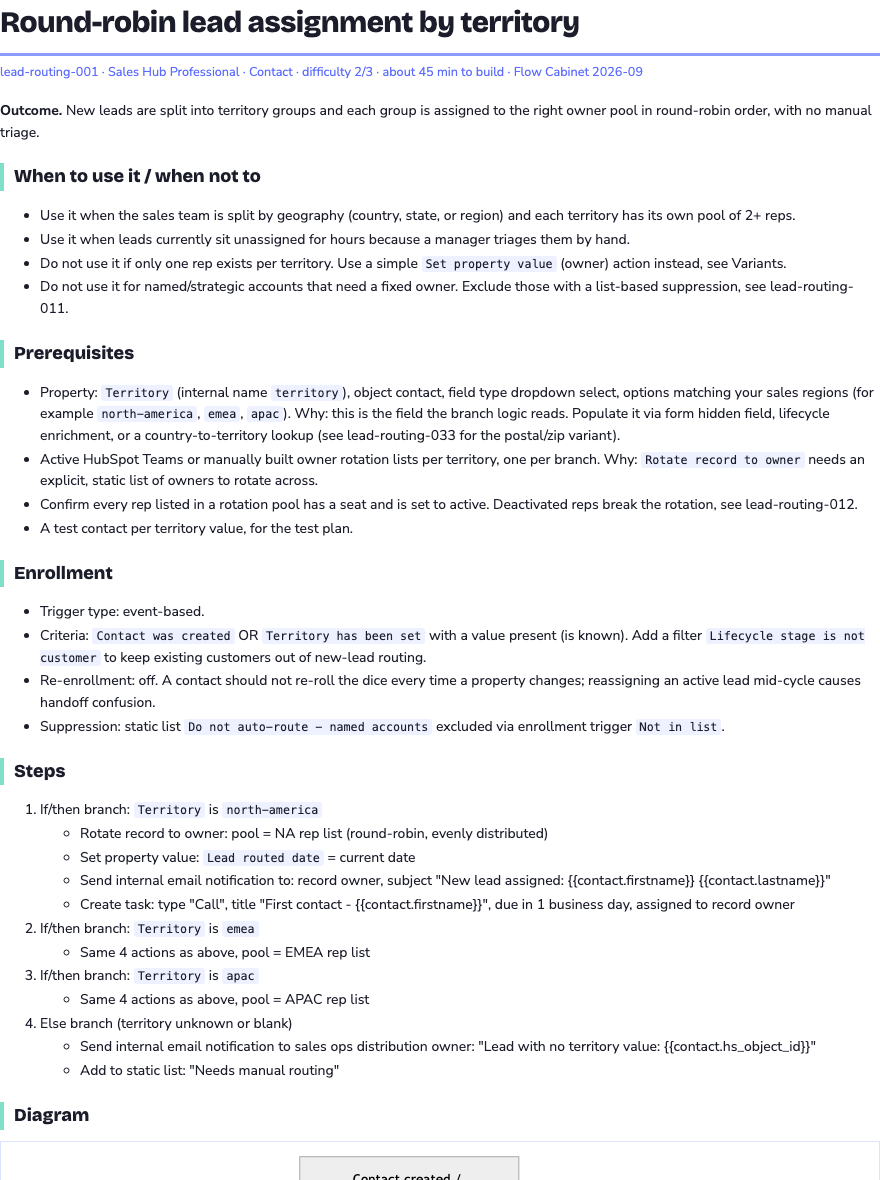
First page of a spec

What breaks, and how the specs prevent it

A renewal date on the account renews one policy

Most HubSpot renewal content puts a contract end date on the company record and builds the cascade from there. That is right for a subscription and wrong for an agency. A household with auto, home and umbrella has three expiration dates, and the account level field can only hold one of them, so the other two renew by memory. This is the reason the kit ships a Policy object and enrolls the cascade on policies, not on accounts.

Delays do not recalculate when the sync moves the date

A delay counted back from an expiration date is scheduled the moment the record reaches that step. If the agency management system sync rewrites the date afterwards, the already scheduled delays keep the old timing and nothing warns you. Re enrollment on the expiration date fixes the timing and restarts the cascade, which is why a notice sent date sits on the policy as the guard that stops a second email going to the insured.

Set property value cannot do arithmetic

When an endorsement is issued, the policy premium has to move by the additional or return premium. No native action adds two numbers, so the recalculation needs a custom coded action on Data Hub Professional, or a person typing the new figure. Portals discover this after building eight steps of the endorsement flow, which is why the no code version is written out in the spec rather than left as an exercise.

What this bundle builds

How the pieces fit together

The Policy object before anything else. Create it, post the properties, and decide there and then which system owns the expiration date and the policy status, because if the agency management system sync and a workflow both write those two fields they will fight quietly for months. Everything in the kit reads them.

Pipelines second. A quote pipeline and a renewal pipeline, kept separate, because a renewal that closes at 95 percent and a new business quote that closes at 20 percent in the same forecast produce a number nobody can use. The renewal of field on the deal is what keeps the two apart in reporting when someone re points an association.

Routing third, since the quote specs all assume a deal has an owner and the licensing check is the one that stops a submission going somewhere it cannot be written.

The service desk is the one block you can build first and independently. It needs SLA targets on the ticket pipeline, which is a setting and not a workflow, and four specs in this kit read the SLA status properties and enroll nothing at all until those targets exist.

What you get

  • 43 specs, from a 25 minute routing rule to a 60 minute renewal cascade
  • Each spec ships as PDF and Markdown
  • Properties JSON: 97 properties across contacts, companies, deals, tickets, quotes and the Policy object, plus the schema body that creates the object itself
  • A README that says what each property is for and which specs break without it
  • Workflow JSON in Automation API format, switched off on import
  • Custom coded actions: one spec needs one, the endorsement premium recalculation, on Data Hub Professional. That spec also ships a no code version
  • A test plan per spec, with the records to create and the history tab to check
  • Variants per spec, including wait until versions of the delay based steps and a Professional shape for the two Enterprise specs
  • One click install for Full and Agency buyers

Who it is for, and who should skip it

Take it if you run the portal for an independent agency or a brokerage and the renewal list still lives in a spreadsheet somebody exports on Mondays. Take it if you are a partner standing up the same insurance setup for the third time and would rather start from a schema than from a blog post about the insurance industry.

Skip it if you are a captive agent working inside a carrier’s own system, since the policy data is not yours to model. Skip the Policy half if the portal is on Professional with no route to Enterprise, and read the Professional variants first to see what you lose. And if renewals are one problem among several rather than the loud one, the full library is the cheaper way to get the routing and the service desk.

What this kit builds

An agency loses premium in three places and never sees it happen. A quote request that waits until the afternoon is a prospect who took the other agent’s call. A policy that renews without a conversation is a policy the insured can be talked out of by a direct writer with a mailer. An endorsement that never makes it back into the record is a renewal priced on last year’s premium.

This kit is the data model and the forty three workflow specs that put all three in one portal. The model comes first: a Policy custom object with policy number, carrier, line of business, premium, effective and expiration dates, commission, status, producer and the renewal fields, associated to contacts, companies, deals and tickets. Around it sit the fields the workflows read: household id and the X date on the contact, industry class, fleet size and loss ratio on the company, premium amount and lines quoted on the deal, claim, certificate and endorsement fields on the ticket. Ninety seven properties in a JSON body you can post, option lists spelled out.

On top of that sit the workflows. The renewal cascade at 90, 60 and 30 days before each expiration, branched by line of business and by loss ratio. Quote chasing from sent to viewed to signed. Routing that checks the producer is licensed where the risk sits. The claims desk with its acknowledgement clock and its pause while the file waits on the carrier. Certificates with the date the general contractor actually needs them by. And endorsements that write the new premium back onto the policy.

It fits an independent agency or brokerage with a book of a few hundred to a few thousand policies, and the operations person who has been asked why the renewal report and the agency management system disagree.

Questions admins ask

How do I track policy renewals in HubSpot?

Put the expiration date on the policy, not on the account, then enroll a filter based workflow on policies that are in force with a known expiration date. Three delay steps count back 90, 60 and 30 days, each one checking a renewal status field so a policy quoted at day 80 stops receiving reminders. The branch on line of business matters: a commercial renewal needs a review meeting and a loss run, a homeowners policy needs a re rate check and twenty minutes.

Does HubSpot have a policy object for insurance?

Not as standard. You create one as a custom object, which needs an Enterprise subscription on at least one hub. The kit ships the schema body, thirteen policy properties and the associations to contacts, companies, deals and tickets. On Professional the workaround is to keep the policy on a closed won deal, which costs you the clean link between one household and its five policies but keeps the renewal reminders running.

What is an X date and where does it live in HubSpot?

The X date is the day a prospect's current policy expires, which is the only day they can realistically move. It is a different field from your own policy expiration date, so the kit keeps two: competitor renewal date on the contact for prospects, expiration date on the policy for clients. The prospect one drives a quarterly touch that stops and hands over to the producer about sixty days out.

Can HubSpot handle claims and certificates of insurance?

As service tickets, yes, and that is the right shape for both: a first notice of loss has an acknowledgement clock and a satisfaction survey at the end, a certificate request has a date the general contractor needs it by. What HubSpot will not do is issue the document or talk to the carrier. The kit tracks the request, the wait, the chase and the turnaround, and says plainly where the carrier portal takes over.

What tier do I need for this?

Two specs need Enterprise, because they touch the Policy custom object, and one of those two also needs Data Hub Professional for the premium recalculation code. One runs as low as Service Hub Starter. The other forty need Professional on Sales Hub, Service Hub or Marketing Hub depending on the spec. Every spec states its own minimum on the first screen, and a Starter only portal cannot run this kit.

Related

Built by a collective of independent HubSpot consultants, ten years of implementations behind them. Searched as: hubspot for insurance, hubspot for insurance agents, hubspot for insurance brokers, hubspot insurance crm, hubspot policy renewal workflow, hubspot insurance pipeline setup. HubSpot calls it: Custom object, Rotate record to owner, Create task, Send internal email notification, Delay until date, Custom coded action. Version 2026-09-19.
199 EUR249
Get this kit