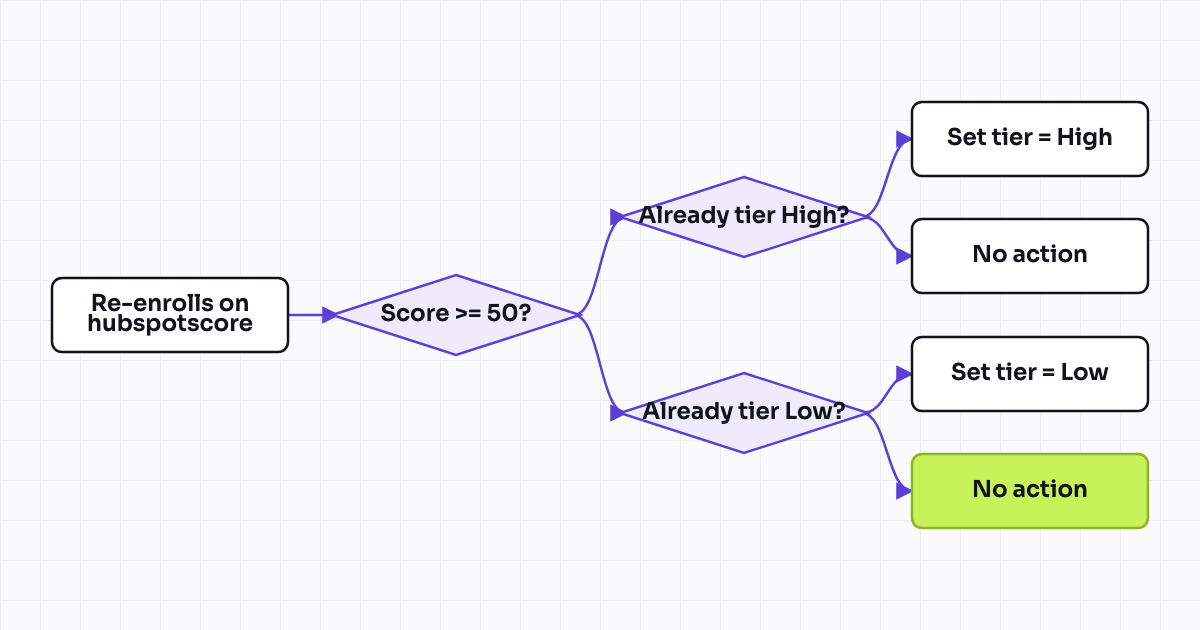
Outcome. Contacts above a lead-score threshold get more direct, sales-adjacent content, while contacts below it stay on a lighter educational track, based on the native HubSpot Score, and each contact only gets re-sent content when they actually cross the line.
Workflow map
Enrollment, branches and actions at a glance
lead-nurturing-010
flowchart TD
    A[Re-enrolls on hubspotscore change] --> B{Score >= 50?}
    B -- Yes --> C{Already tier High?}
    C -- No --> D[Set tier = High, send high-intent email]
    C -- Yes --> E[No action]
    B -- No --> F{Already tier Low?}
    F -- No --> G[Set tier = Low, send educational email]
    F -- Yes --> H[No action]
When to use it, when not to
- UseUse once a HubSpot Score model (or a custom score property) is already configured and checked against real conversions, not a rough guess.
- UseUse it to route content intensity, not to replace lead-routing's assignment logic. A high score here still needs a real routing fiche to reach a rep.
- SkipDo not use it if the score model has never been checked against actual closed-won deals. Branching content on an unproven score wastes the "high-intent" track on contacts who are not, in fact, more likely to buy.
- SkipDo not use it as the sole gate before a sales handoff. Combine with an explicit intent signal, such as lead-nurturing-012, before creating a task for a rep.
The preview ends here. Six sections are in the library.
counted, not blurred
PrerequisitesEvery property with its label, internal name, type and options, plus the assets the workflow needs before you start.3 items
EnrollmentThe trigger, the criteria exactly as they are ticked in the UI, the re-enrollment rule and the suppression list.4 parts
StepsEach action in order with its parameters, its branches and its delays, written as you tick them.8 numbered actions
Known pitfallsTraps seen in production, each with what breaks and what to do instead.4 pitfalls
Test plan, variants and build specHow to prove it works in a test portal, where to look when it does not, the variants for other objects or tiers, and the YAML build spec.3 variants, 3 sections
FilesThe properties JSON creates the fields in one API call, the workflow JSON documents the build.PDF, Markdown, JSON
Install1 click. The installer creates the properties this spec declares and the workflow itself, switched off, then opens a task for the prerequisites that are assets rather than properties, such as a team, a static list or a marketing email. What it created is listed on the install page.1 click, switched off
Unlock the full library,
149 EUR
or the lead nurturing pack, 39 EUR
One-time, excl. VAT. 30-day refund, no questions asked. Founding prices until 31 October, then 199 and 59 EUR. Includes every spec added later, up to the full 500, and the one-click installer on the full library. Building on client portals? The agency licence at 449 EUR covers unlimited client portals.