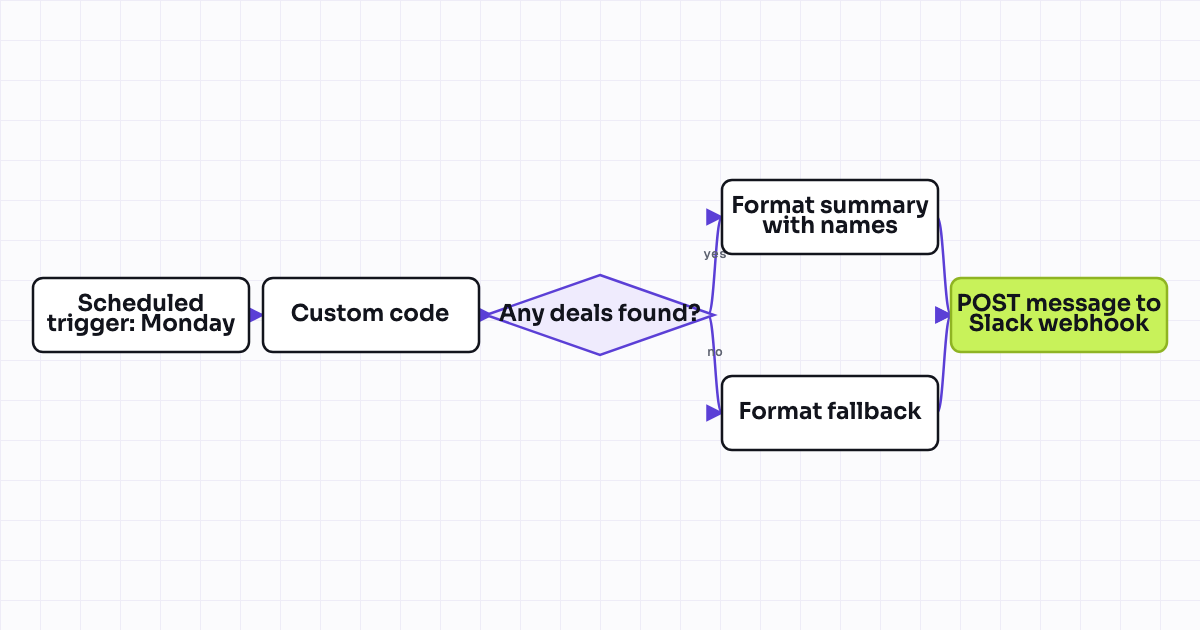
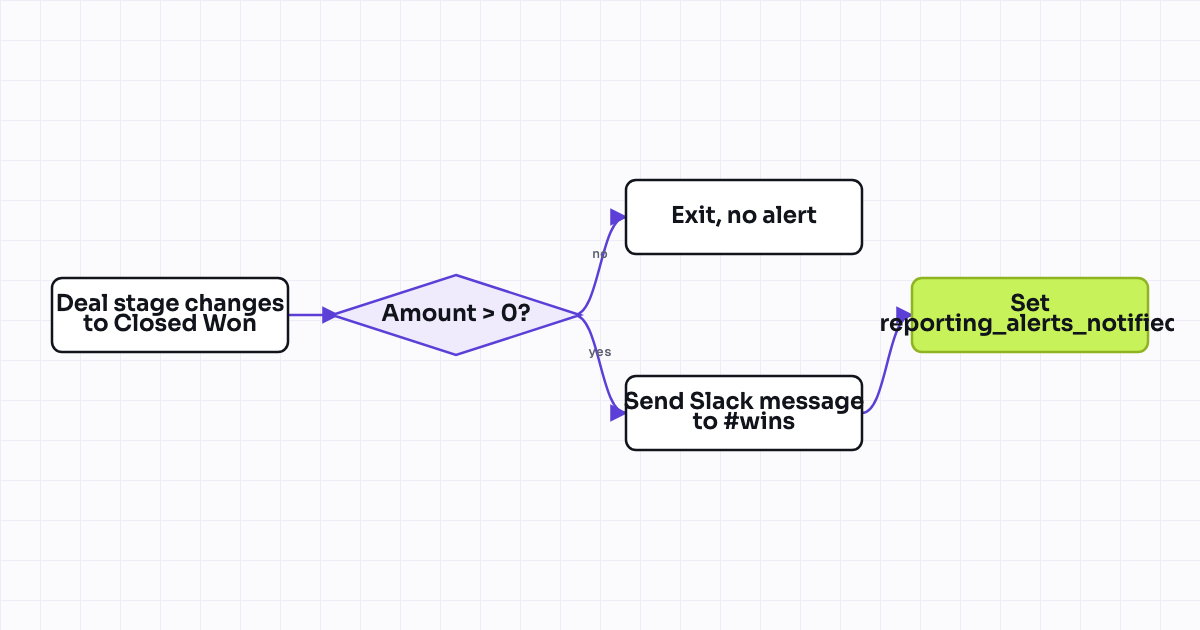
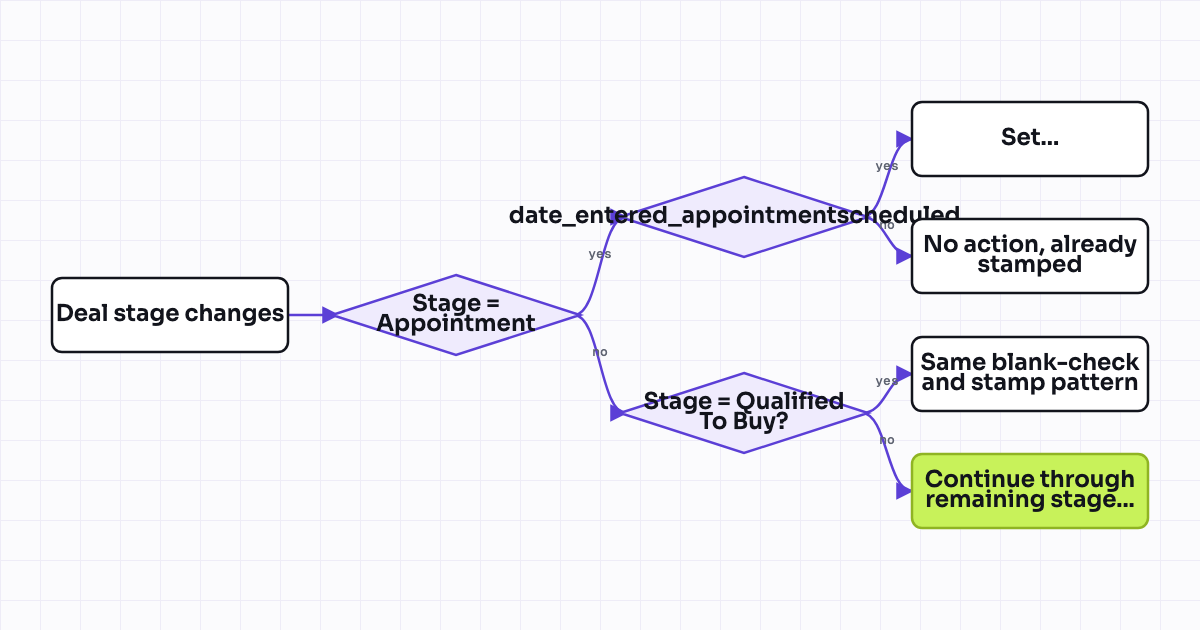
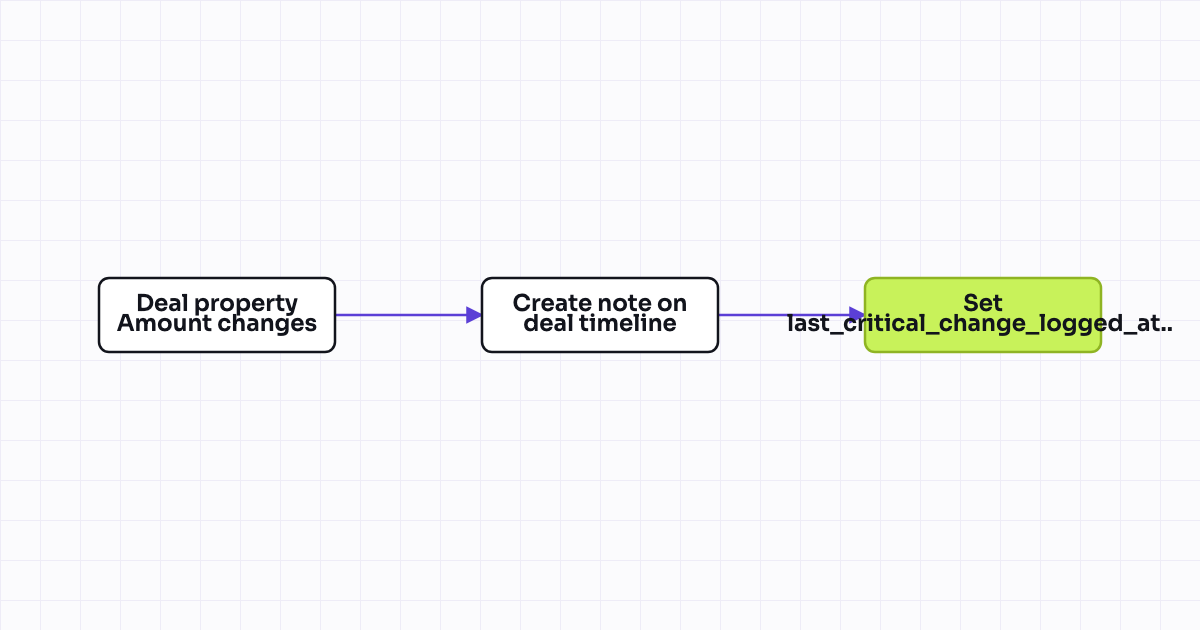
Outcome. An agent runs on the records you choose, at the moment you choose, with a run counter, a status property and an error path, so you can tell later what it did and what it cost.
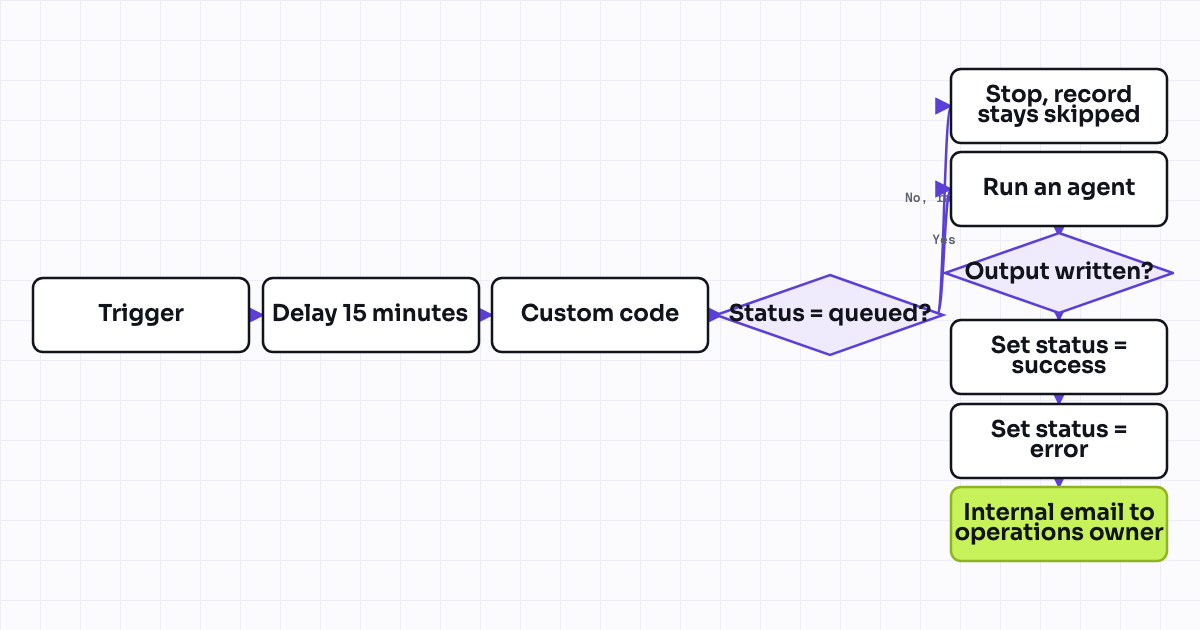
Workflow map
Enrollment, branches and actions at a glance
reporting-alerts-050
flowchart TD
    A[Trigger: created, property changed or schedule] --> B[Delay 15 minutes]
    B --> C[Custom code: rate limit gate, stamp status and counter]
    C --> D{Status = queued?}
    D -->|No, rate limited| E[Stop, record stays skipped]
    D -->|Yes| F[Run an agent, output to Agent run output]
    F --> G{Output written?}
    G -->|Yes| H[Set status = success, stamp last run at]
    G -->|No| I[Set status = error]
    I --> J[Internal email to operations owner]
When to use it, when not to
- UseUse it as the base pattern under any agent-driven automation. The agent does the thinking, this workflow decides which records reach it and how often.
- UseUse it when you need an audit trail of AI runs. Without a status property and a counter, an agent run leaves almost nothing behind and nobody can answer "why did this record get processed twice".
- SkipDo not point an agent at a whole database on a schedule to see what happens. Every enrolled record is one run against the portal credit balance, and a schedule that matches 10 000 contacts spends 10 000 runs each time it fires. (check in your portal: how a single Run an agent execution is metered against the portal credit balance, and whether a failed run still consumes credits)
- SkipDo not trigger on a property the agent itself writes. That is a loop, and with re-enrollment on it is an expensive one.
The preview ends here. Six sections are in the library.
counted, not blurred
PrerequisitesEvery property with its label, internal name, type and options, plus the assets the workflow needs before you start.9 items
EnrollmentThe trigger, the criteria exactly as they are ticked in the UI, the re-enrollment rule and the suppression list.12 parts
StepsEach action in order with its parameters, its branches and its delays, written as you tick them.10 numbered actions
Known pitfallsTraps seen in production, each with what breaks and what to do instead.7 pitfalls
Test plan, variants and build specHow to prove it works in a test portal, where to look when it does not, the variants for other objects or tiers, and the YAML build spec.4 variants, 3 sections
FilesThe properties JSON creates the fields in one API call, the workflow JSON documents the build, and the custom coded action ships as a ready-to-paste .js file.PDF, Markdown, JSON, code
Install1 click. The installer creates the properties this spec declares and the workflow itself, switched off, then opens a task for the prerequisites that are assets rather than properties, such as a team, a static list or a marketing email. What it created is listed on the install page.1 click, switched off
Unlock the full library,
149 EUR
or the reporting and alerts pack, 39 EUR
One-time, excl. VAT. 30-day refund, no questions asked. Founding prices until 31 October, then 199 and 59 EUR. Includes every spec added later, up to the full 500, and the one-click installer on the full library. Building on client portals? The agency licence at 449 EUR covers unlimited client portals.