Outcome. A lead captured through the mobile app reaches the team trained on the app experience, and a web-form lead reaches the standard web team, instead of both going through one generic queue that treats the two channels the same.
Workflow map
Enrollment, branches and actions at a glance
lead-routing-045
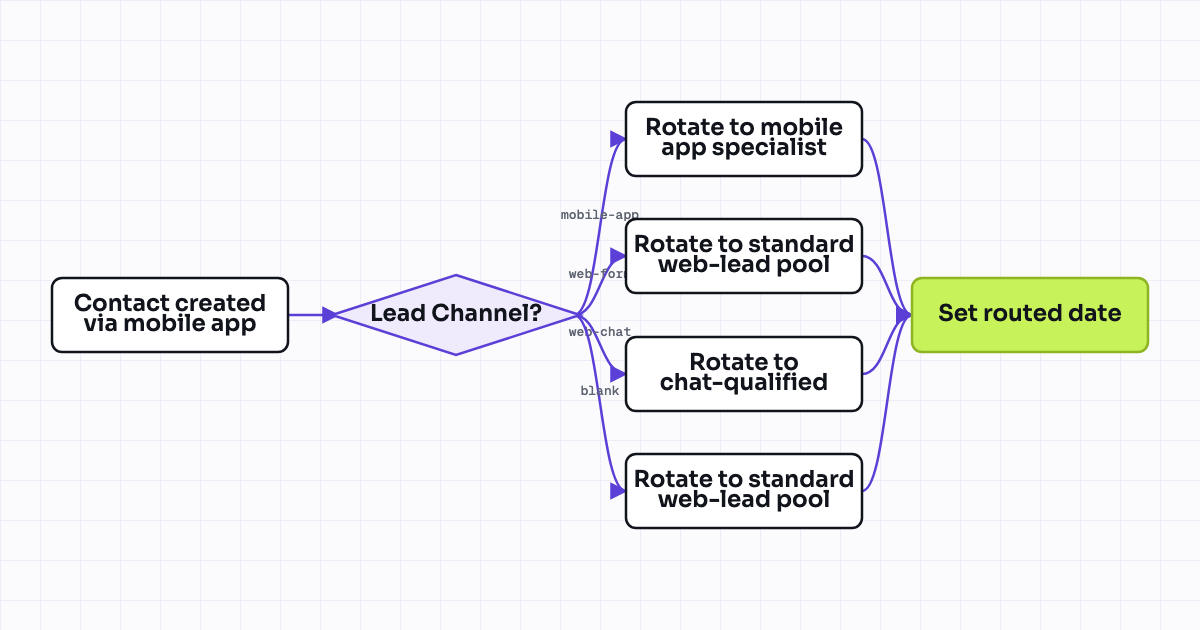
flowchart TD
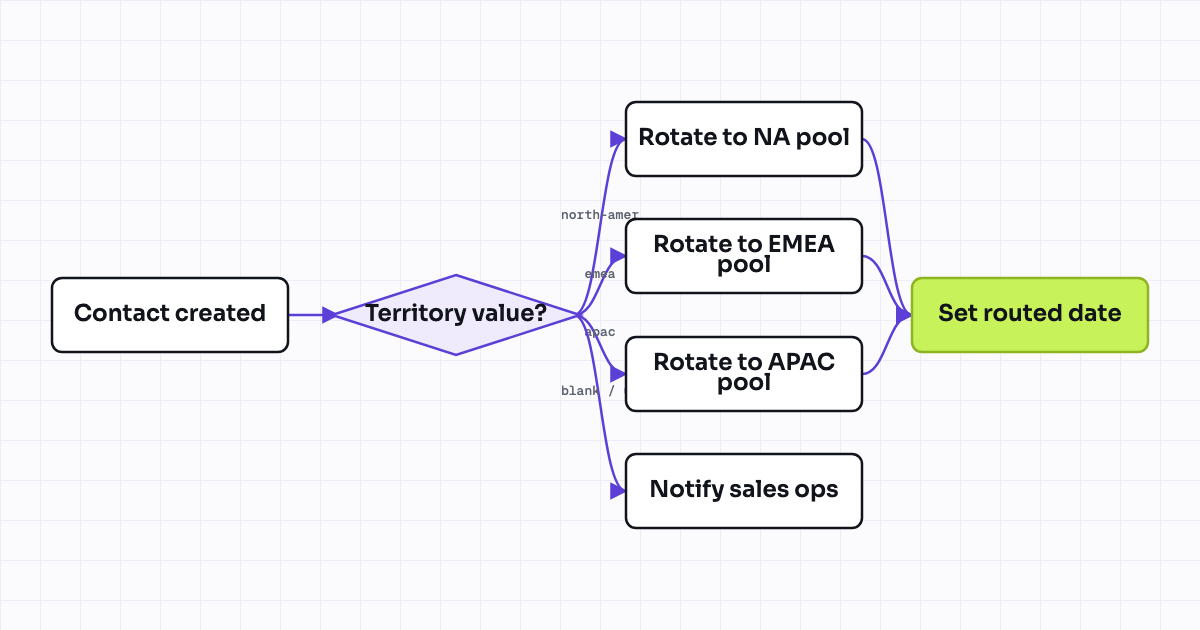
    A[Contact created via mobile app or web intake] --> B{Lead Channel?}
    B -->|mobile-app| C[Rotate to mobile app specialist team]
    B -->|web-form| D[Rotate to standard web-lead pool]
    B -->|web-chat| E[Rotate to chat-qualified lead pool]
    B -->|blank| F[Rotate to standard web-lead pool + notify sales ops]
    C --> G[Set routed date, notify owner, create call task]
    D --> G
    E --> G
    F --> G
When to use it, when not to
- UseUse it when mobile app leads and web leads genuinely need different follow-up (different product context, a different onboarding flow, or a team specifically trained on the app).
- UseUse it when the mobile app and the website use separate, distinct HubSpot forms or a distinct integration path, so the channel is knowable at intake without guessing from a browser string.
- SkipDo not use it if a single form serves both channels identically embedded in the app's webview and the website; there is no reliable signal to branch on in that case, fix the intake separation first.
- SkipDo not use it expecting a native "device type" contact property; standard analytics device data exists at the page-view and session level, not as a persistent contact property.
The preview ends here. Six sections are in the library.
counted, not blurred
PrerequisitesEvery property with its label, internal name, type and options, plus the assets the workflow needs before you start.4 items
EnrollmentThe trigger, the criteria exactly as they are ticked in the UI, the re-enrollment rule and the suppression list.4 parts
StepsEach action in order with its parameters, its branches and its delays, written as you tick them.15 numbered actions
Known pitfallsTraps seen in production, each with what breaks and what to do instead.4 pitfalls
Test plan, variants and build specHow to prove it works in a test portal, where to look when it does not, the variants for other objects or tiers, and the YAML build spec.3 variants, 3 sections
FilesThe properties JSON creates the fields in one API call, the workflow JSON documents the build.PDF, Markdown, JSON
Install1 click. The installer creates the properties this spec declares and the workflow itself, switched off, then opens a task for the prerequisites that are assets rather than properties, such as a team, a static list or a marketing email. What it created is listed on the install page.1 click, switched off
Unlock the full library,
149 EUR
or the lead routing pack, 39 EUR
One-time, excl. VAT. 30-day refund, no questions asked. Founding prices until 31 October, then 199 and 59 EUR. Includes every spec added later, up to the full 500, and the one-click installer on the full library. Building on client portals? The agency licence at 449 EUR covers unlimited client portals.