Outcome. A lead gets routed by logic a native workflow cannot express (a live capacity count, a complex weighting formula, a cross-portal lookup), computed by an external tool and written back to the record, without the team giving up HubSpot as the system of record.
Workflow map
Enrollment, branches and actions at a glance
lead-routing-040
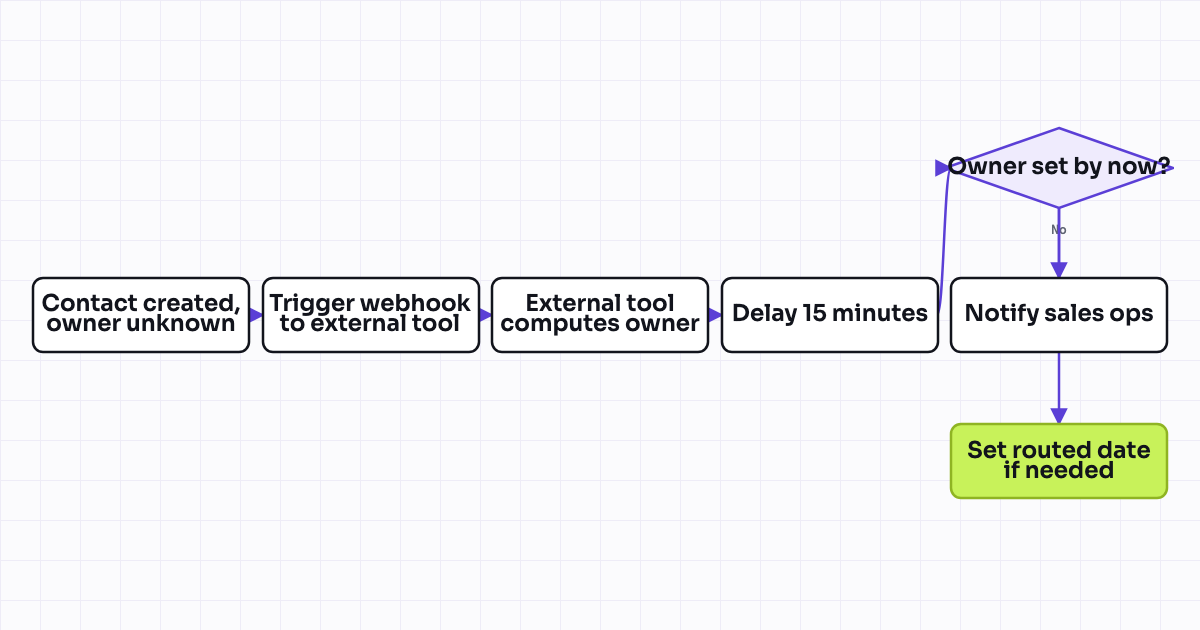
flowchart TD
    A[Contact created, owner unknown] --> B[Trigger webhook to external tool]
    B --> C[External tool computes owner, calls HubSpot API to set it]
    C --> D[Delay 15 minutes]
    D --> E{Owner set by now?}
    E -->|No| F[Notify sales ops, rotate to fallback pool]
    E -->|Yes| G[Set routed date if needed, notify new owner]
When to use it, when not to
- UseUse it once a genuine native limit has been hit: a true real-time capacity cap (see lead-routing-025), a weighting formula with more branches than random-split can cleanly express (see lead-routing-014), or a rotation that depends on data HubSpot does not natively hold (an external scheduling system's live availability, for example).
- UseUse it as an escape hatch, not a default. If a native pattern from lead-routing-001 through lead-routing-039 already covers the need, build that first, it is simpler to maintain and does not depend on an external system staying online.
- SkipDo not use it if the team has no existing Zapier, Make, or custom middleware capability; standing up that infrastructure only to solve a routing problem is a heavier lift than the workflow itself.
- SkipDo not use it as a way to avoid documenting the actual routing rule; the external tool's logic still needs to be as clearly documented as a native workflow would be, or it becomes an unmaintainable black box.
The preview ends here. Six sections are in the library.
counted, not blurred
PrerequisitesEvery property with its label, internal name, type and options, plus the assets the workflow needs before you start.5 items
EnrollmentThe trigger, the criteria exactly as they are ticked in the UI, the re-enrollment rule and the suppression list.4 parts
StepsEach action in order with its parameters, its branches and its delays, written as you tick them.7 numbered actions
Known pitfallsTraps seen in production, each with what breaks and what to do instead.4 pitfalls
Test plan, variants and build specHow to prove it works in a test portal, where to look when it does not, the variants for other objects or tiers, and the YAML build spec.3 variants, 3 sections
FilesThe properties JSON creates the fields in one API call, the workflow JSON documents the build.PDF, Markdown, JSON
Install1 click. The installer creates the properties this spec declares and the workflow itself, switched off, then opens a task for the prerequisites that are assets rather than properties, such as a team, a static list or a marketing email. What it created is listed on the install page.1 click, switched off
Unlock the full library,
149 EUR
or the lead routing pack, 39 EUR
One-time, excl. VAT. 30-day refund, no questions asked. Founding prices until 31 October, then 199 and 59 EUR. Includes every spec added later, up to the full 500, and the one-click installer on the full library. Building on client portals? The agency licence at 449 EUR covers unlimited client portals.